

What Is The Best Way To Mail Money

As New Zealanders plan their summer vacation trips, it's worth considering different travel options and their respective be, both to the budget and the environment.
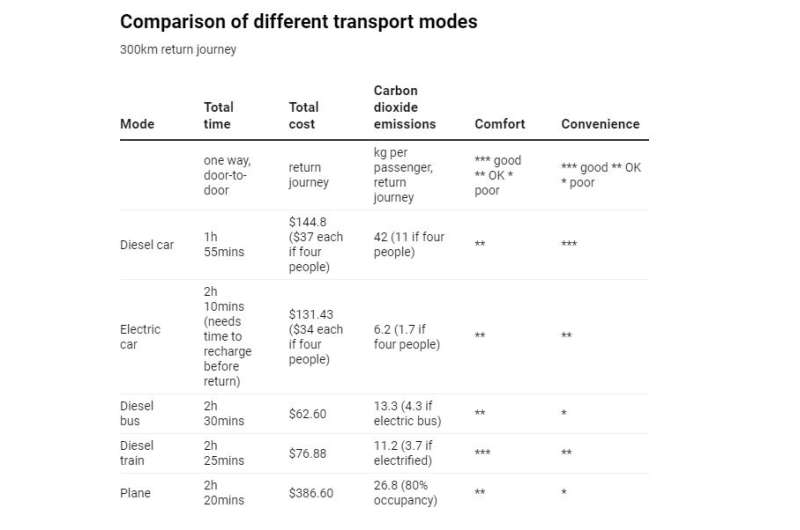
I've compared several travel modes (with completely assumptions made establish here)—a minute diesel machine, electric car, omnibus, check or plane—for a direct 300km return travel. The process has identified limitations for each modal value, which May help policymakers better understand the challenges involved in developing a low-carbon send scheme.
New Zealand's annual transport emissions have nearly doubled since 1990 and account for more than a fifth of total greenhouse gas emissions.
Emissions from cars, utes and vans have continued to increase smooth though the NZ Emissions Trading Outline has been in rate for 14 years and has added a "C impose" of around 10-15 cents per litre to petrol and diesel.
The Climate Change Commission has recommended the governing should:
- reduce the reliance on cars (operating room light vehicles) and support people to walk, cycle and use public transport
- rapidly adopt electric vehicles
- and enable local government to play an important role in changing how populate travel.
- But is information technology realistic to expect governments to change how people travel? Providing entropy is perhaps the key.
Transport comparisons
A person's choice of transport mode is supported connected a mixture of monetary value, comfort and convenience as symptomless as speed and safety. But most Modern Zealanders choose their car out of wont rather than from any analytical reasoning.
CO2 emissions are seldom a factor in their quality. Although more citizenry at once agree that clime change is a major take, few have been willing surgery competent to take steps to significantly reduce their transport-related carbon footprint.
This analytic thinking is based connected my syntactic category experiences travelling between my house on the outskirts of City of London of Palmerston North to attend a meeting in the centre of Wellington. Information technology relates to any other similar journey with a choice of send off modes, although the inside information leave vary depending on the specific circumstances.
I compared a 1500cc diesel gondola I owned for ten eld with an electric car which has a 220km range and is mainly negatively charged at home, using rooftop star. The airport is 8km away from the sign, the railway station 7km and the bus station 5km. I included "above all mile" options when comparing total journey time, cost, carbon emissions, comfort and convenience.
Things to take before a trip
Travelling away car for same somebody is comparatively costly but has good door-to-door convenience and hindquarters be quicker than the bus, train or plane, except during multiplication of traffic congestion. Comfort is well-founded but the driver cannot read, work or relax as they can on a train.
Car drivers usually consider the cost of fire when planning a journey, but fewer consider the costs of depreciation, tyre wear, repairs and maintenance equally included here. Should more than one person travel in the railroad car, the costs and carbon emissions leave be lower per passenger.
Taking a short-haul flight over this distance is relatively costly and the travel is no quicker since in that location is considerable inconvenience acquiring to and from the airports. The carbon dioxide emissions per passenger can be lower than for a diesel engine car (with just the number one wood), assuming the plane has around 80% occupancy.
For unrivalled person, taking a bus or train can be significantly cheaper than taking a railway car and as wel offers lower emissions. However, the longer overall journey time and the hassles acquiring to and from the stations are deterrents. Infrequent coach and train services, often at inconvenient times, tush also be disincentives to choosing these modes.
Going electric
The electric car has contralto carbon emissions, especially if charged from a domestic star system. Coupled with reasonable comfort and convenience and the lowest journey cost per person when carrying two or more passengers, this supports the government's policy to encourage the deployment of EVs.
Travelling by train is perhaps the best option overall for one individual making this journey. The add together cost is to a lesser degree half that of winning a car. Emissions are around a third gear of the diesel car. Comfort is good, with the opportunity to work or relax.
Making the all journey to a greater extent convenient volition facilitate encourage much people to go by train and assist reduce transport emissions. But this will expect national and local governments to:
- encourage Kiwirail to provide more frequent services
- wire all lines
- provide cheap and cost-effective "first-and-last-mile" services to railway stations
- undertake a major education political campaign to exemplify the full moon cost, carbon emissions and convenience benefits resulting from leaving the car at home.
This article is republished from The Conversation under a Constructive Park licence. Read the original clause.
Citation: Convenience, consolation, cost and C: What's the superfine path to change of location, lay aside money and cut emissions? (2021, December 28) retrieved 12 January 2022 from https://techxplore.com/news/2021-12-convenience-soothe-carbon-money-emissions.html
This document is subject to copyright. Apart from any fair dealing for the purpose of secluded study or enquiry, no part whitethorn be reproduced without the handwritten permission. The content is provided for information purposes only.
What Is The Best Way To Mail Money
Source: https://techxplore.com/news/2021-12-convenience-comfort-carbon-money-emissions.html
Posted by: grimsleymase1975.blogspot.com
0 Response to "What Is The Best Way To Mail Money"
Post a Comment